100000 +
Happy Customer

Dr-NBFC business strategy service has been instrumental in our success. Their tailored strategies ha..

Happy Customer
CA & Lawyers
Offices
What we will do

Company incorporation and opening a corporate bank account take 15 days each to complete.

Preparing a detailed business plan takes up to 15 days to complete.

Injecting capital into the business and collecting documents takes 30 days to complete.
Filing and reviewing the application and obtaining RBI feedback takes about 30 days to complete.
First-level approval by RBI, reflecting successful evaluation and taking the process forward, takes 15 days to complete.
At DrNBFC, we are leading the industry with an 85% market share. Our NBFC registration solutions ensure a 100% success rate.
A non-banking financial company or NBFC registration refers to a financial institution that is incorporated under the Companies Act, 2013. A registered NBFC is eligible to offer various financial services, including asset financing, loans, credit facilities, and investment.
Businesses seeking NBFC registration in India are required to fulfil various compliance requirements, including a minimum net owned fund (NOF) of ₹10 crore. It is also mandatory to obtain a Certificate of Registration (CoR) from the Reserve Bank of India (RBI) under Section 45-IA of the RBI Act, 1934.
The NBFC registration process involves a stepwise procedure, including company incorporation, collecting the relevant paperwork, and submitting an online application through the RBI Pravaah portal. Once completed, the applicant company must submit the documents in person at the regional RBI offices. Talk to DrNBFC consultants for worry-free and quick Non-Banking Financial Company registration in India.
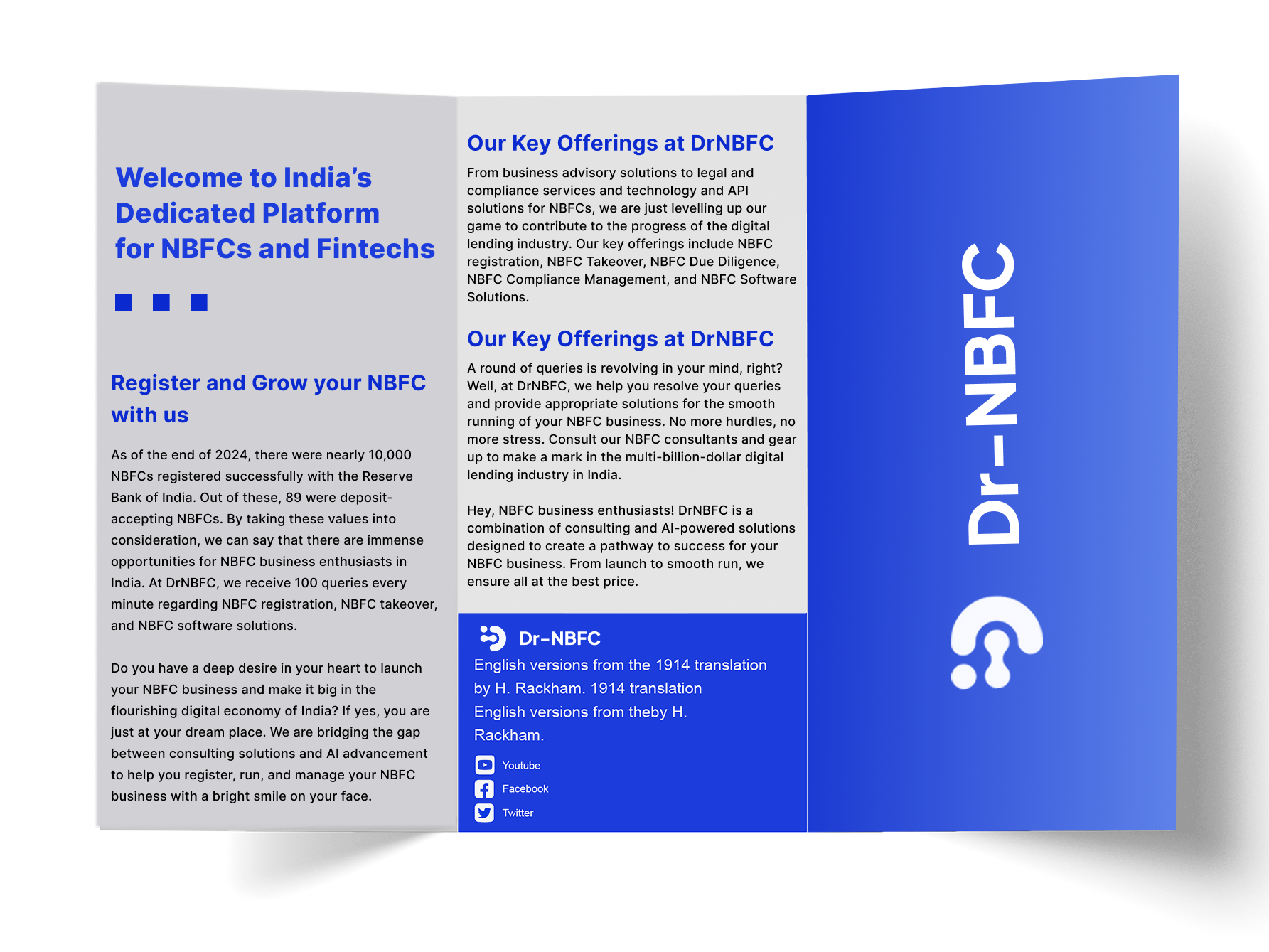
Get your service-specific brochure here
An NBFC license in India enables companies to provide financial services legally. Additionally, it serves as a gateway to earn credibility, attract investors, and access broader credit markets, aligning with the compliance guidelines and regulations of the Reserve Bank of India (RBI).
NBFC registration in India is a complex and time-consuming process. It takes between 90 to 180 days to complete the end-to-end NBFC registration. However, to meet this timeline, entrepreneurs must follow the stepwise procedure to register NBFC in India and submit the relevant documents on time.
They must also ensure the correctness and accuracy of the overall process to be able to obtain their NBFC license for legal operations. In order to register NBFC in India effortlessly and conveniently, reach out to DrNBFC consultants.
The first step in the process involves registering the company under the Companies Act, 2013. We help you register your company.
The next step for NBFC registration requires creating and submitting a detailed business plan to the RBI. Our DrNBFC team will help you out.
The next step involves evaluating the application by the RBI and validating its correctness in line with the compliance requirements.
The next step involves collecting all relevant documents like PAN cards, MoA, and AoA and submitting them on the Pravaah Portal for NBFC incorporation.
The final step involves document verification by the RBI and, once completed, the issuance of the NBFC registration certificate, which enables legal operations.
Not able to find the right NBFC registration consultants yet? DrNBFC is here to deliver end-to-end NBFC registration solutions & quick processing.
DrNBFC’s expert guidance helps you become a part of the dynamic financial ecosystem, where NBFCs capture a 41% share in the microfinance sector of India.
| Aspect | Non-Banking Financial Company (NBFC) | Bank |
|---|---|---|
| Regulatory Authority | Regulated by the RBI under the Reserve Bank of India (RBI) Act, 1934 | Regulated by the RBI under Banking Regulation Act, 1949 |
| License Requirement | NBFC License from RBI | Banking license from RBI |
| Demand Deposit | Not eligible to accept demand deposits, such as savings | Eligible to accept demand deposits like saving and current account |
| Payment & Settlement System | Not a part of the payment and settlement system | Part of the payment and settlement system |
| Cheque Issuance | Not eligible to issue cheques | Eligible to issue cheques |
| CRR & SLR Compliance | Not mandatory to maintain CRR and SLR | Mandatory to maintain CRR and SLR |
| Operational Priority | Priority on giving loans, leasing, investment and financial services | Priority on delivering different banking services |
| Foreign Investment | Eligible to receive 100% FDI | Eligible to receive 74% FDI in private sector |
| Credit Creation | Not eligible to create credits like the banks | Eligible to create credits through lending and deposit mobilization |
| Scope of Service | Limited to financial services like loans, leasing and investment | Includes offering full range of financial services, such as savings and loans |
A non-banking financial company registration must be done in accordance with the RBI Act, 1934. NBFCS must follow all the financial, operational and reporting guidelines listed by the RBI.
Companies with a minimum capital requirement of ₹2 crore net owned funds (₹10 crore for NBFC-IFC) are eligible to apply for NBFC registration in India.
NBFC license in India is issued only to businesses that meet all the compliance requirements, including registration under the Companies Act, 2013.
Unlike traditional banks, businesses with NBFC incorporation are not eligible to accept demand deposits from the public to facilitate financial system stability.
It is not mandatory for businesses with legal NBFC registration to maintain a Cash Reserve Ratio (CRR) or Statutory Liquidity Ratio (SLR), unlike traditional banks operating in India.
In accordance with the RBI Act, 1934 and Companies Act, 2013, companies are mandated to comply with the following checklist for NBFC incorporation in India.
It is important for the applicants to incorporate a company under the Companies Act, 2013.
The applicants must fulfil the requirement of a minimum net owned fund (NOF) of ₹10 crore.
It is mandatory to submit a five-year financial forecast and a detailed business plan to obtain NBFC registration in India.
The NBFC must onboard at least one director with the required financial sector experience to meet regulatory requirements and operate seamlessly.
The promoters and directors must have a clean history with no financial or criminal record in their name.
The applicants must meet online NBFC registration requirements through the Pravaah portal and submit documents physically to the regional RBI office.
NBFC registration requires the submission of various documents, including the following:
Before Since 2020, RBI has mandated businesses with NBFC license to comply with the following post-online NBFC registration requirements:
NBFC registration makes it necessary to register with at least one Credit Information Company for reporting borrower data and accessing credit history records.
Financial Intelligence Unit-India registration is mandatory to maintain an NBFC license in India. FIU-IND registration helps report suspicious financial transactions and meet PMLA compliance guidelines.
CKYC (CERSAI) registration is a mandatory post-registration compliance for NBFC incorporation. This registration facilitates central KYC compliance and helps upload customer data to the CKYC Registry.
Online NBFC registration mandates implementing and following the Fair Practice Code to facilitate transparent lending practices. It also helps protect borrower rights and disclosures.
Offering Anti-Money Laundering and Combating Financing of Terrorism training to employees is one of the most significant compliances that non-banking financial company registration must undertake to meet regulatory compliance and promote risk detection.
All businesses that have secured NBFC company registration online must adopt a board-approved risk management policy covering credit, liquidity, and operational risk management processes.
To maintain online NBFC registration, it is important to file returns, including DNBS01, DNBS02, DNBS03, DNBS04A, DNBS04B, DNBS06, DNBS10. Returns that align with RBI timelines help maintain regulatory and financial compliance.
Filing of Form A return annually is mandatory for maintaining NBFC registration, which helps meet the compliance of minimum NOF and prudential norms prescribed by the RBI.
Another important post-registration compliance for upholding an NBFC license in India is to maintain the Capital to Risk-weighted Assets Ratio (CRAR) as per RBI guidelines, facilitating solvency and capital adequacy.
Maintaining Liquidity Coverage Ratio (LCR) and leverage ratio thresholds are significant post-registration compliances mandated for asset-liability and funding stability for NBFC license in India.
Before NBFCs offer a range of services, like loans, asset financing, and investment management, to people and businesses not served by traditional banks. Types of NBFC registration on their functions and activities include the following:
NBFC registration as ICCs deliver financial services, including loans, investments, and credits, enhancing credit availability. They also promote financial inclusion across different sectors.
CICs are businesses with NBFC licenses that primarily invest in the shares of group companies which are not involved in trading or services. The CICs support growth and partnerships through capital management.
NBFC incorporation as IFCs fund large infrastructure projects, supporting long-term investments. They finance and develop critical infrastructure, including highways, ports, and energy systems.
IDF-NBFCs direct investments into infrastructure debts by facilitating long-term debt financing for infrastructure projects. This is achieved through bonds that support economic development across various sectors, including energy, transportation, and urban development.
Non-banking financial company registration as MFIs specializes in offering collateral-free small loans to low-income individuals and groups. They provide financial assistance to underserved communities, helping them meet their personal and business needs.
NBFC license in India as factoring NBFCs are involved in buying receivables from businesses, facilitating immediate cash flow. They are crucial in helping businesses convert outstanding invoices into liquid assets to handle working capital and boost operational efficiency.
NBFC incorporation, as MGCs, specializes in offering mortgage guarantees to lower lenders' risk, facilitating home loan approvals and stimulating the growth of the housing sector, particularly for first-time buyers.
NBFC registration as P2P lending platforms connect borrowers and lenders online. Unlike traditional banks, these platforms offer dynamic interest rates and flexible terms, promoting alternative financing options for borrowers and investors.
Before Another type of classification for NBFC registration is based on the regulatory norms set by the Reserve Bank of India, which mandates each type to fulfil different compliance requirements.
NBFC registration as NBFC-BL refers to non-deposit-taking NBFCs with an asset value below ₹1,000 crores. Base Layer NBFC must fulfil the annual compliance requirements to be eligible to offer loans to low-income groups.
Middle Layer NBFCs include both deposit-taking and non-deposit-taking NBFCs. NBFC license as NBFC-ML allows these businesses to manage more important assets than the Base Layer NBFCs. However, NBFC-MLs must fulfil the compliance requirements on a quarterly basis.
NBFC incorporation as NBFC-UL includes the top 10 NBFCs recognized by the RBI, depending on asset size and risk profile. The Upper Layer NBFCs must fulfil monthly compliance requirements owing to their significant influence in the financial market.
NBFC company registration online, as an NBFC-TL, is subjected to stringent regulatory supervision due to its size and effect on the financial system. Top Layer NBFCs operate under the strict regulatory norms of the RBI.
Before Given below are the revenue streams for NBFCs with a NBFC License in India-
Before DrNBFC is India’s leading NBFC consulting and aggregator platform. 99 out of 100 NBFC business hustlers trust us for online NBFC registration, compliance management, and software solutions. Given below are the reasons why we are the ultimate choice for NBFC license in India-
NBFCs are non-banking financial corporations in India. NBFC registration is the legal pathway to incorporate an NBFC by following the due procedure. NBFCs require a license to deliver their services. They are regulated by the RBI under the Reserve Bank of India (RBI) Act, 1934. NBFCs must obtain a Certificate of Registration (CoR) from the RBI under Section 45-IA, which facilitates non-deposit-taking firms in providing lending, leasing, and investment services legally.
Obtaining an NBFC license in India is a systematic and rigorous process, which is regulated by the Reserve Bank of India. However, the applicants must fulfil all the compliance requirements to be eligible for NBFC company registration online. It is mandatory to incorporate a company under the Companies Act, 2013. They must also maintain a minimum Net Owned Funds (₹10 Crore from 1 October 2022) and ensure that their principal business is financial activity. Other eligibility criteria include a capital injection as Tier 1 capital, no borrowed capital to launch operations, and a minimum of 10 years of management experience. The applicants must also be experienced in credit, risk, and retail and be able to submit a detailed business plan.

Global Incorporation
International
Branches
SLA Delivery
Customer Rating


99% Success Rate

Quick Turnaround Time

No Hidden Charges

Dedicated Experts